According to a study by INSEE (the French National Institute of Statistics and Economic Studies), published on April 16, the ratio between the average income of the poorest 10% and that of the richest 10% falls from 26 before public transfers to 3.5 after redistribution.
This mechanism for reducing inequalities leads France to redistribute more than it collects, by about €1,400 per year per household, with this additional cost financed through public debt.
Thus, in 2023, while the average income in France before redistribution stood at €44,300 per consumption unit (INSEE’s household measure), it reached €45,700 after redistribution.
In total, 56% of French households received more than they paid in 2023.
And elsewhere?
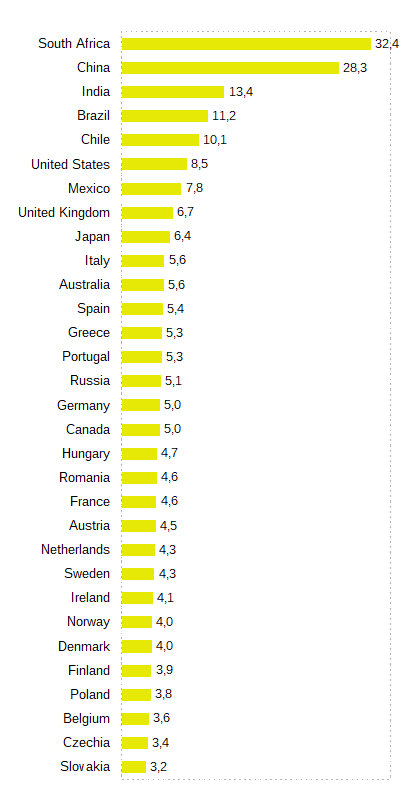
The ratio between the average income of the richest 20% and that of the poorest 20% (the S80/S20 ratio) is a useful indicator of inequality-reducing mechanisms.
The OECD has published S80/S20 ratios for the year 2023:
Sources :
– INSEE | Revenus
familiaux – OCDE | Répartition des revenus